Although some traditional board games still dominate the market (Chess, Checkers, Backgammon, Scrabble, Monopoly, Clue, Othello, Trivial Pursuit, Pictionary, and Risk as the top ten), table top games have seen in recent years a resurgence, a diversification, and a deepening.
A couple of theories. First, I think many
Eurogames have finally come into the mainstream. Eurogames, which for a long time were indie games in the United States, only found in hobby stores or on-line, have now made their way into big box stores like Target and Barnes & Noble. Chief among the Eurogames is Settlers of Catan, whose fame was ensured this last year when everyone learned the
Packers played Catan. Eurogames are attractive for many reasons, including their abstract playing pieces, shorter play time, simplified rule structures, shift towards economic rather than military strategy, focus on strategy over luck, and no player elimination.
Eurogames
 |
| Hand-sculpted 3-D Homemade Version of Catan |
If you're interested in Eurogames, you can't go wrong with Catan. It's a fun and accessible turn-based resource development game, and the design is gorgeous. If you want to swim upstream, consider
Agricola (a medieval, agricultural resource management turn-based system),
Ticket to Ride, a railway-themed German-style game, or
Power Grid, an electric-supply grid game. A couple of other games comparable to these that
BoardGameGeek rank high include
Puerto Rico, Carcassonne, or the cooperative game
Pandemic. I love the first two. Pandemic I could take or leave, but many people I know love it.
The best thing about Eurogames is the enjoyable game-play that is also strategically challenging. And because they reliably last approximately one hour to 90-minutes in duration, players can plan around a game.
Card Games
But Eurogames aren't the only games that have seen a resurgence in the last few years. A variety of card-games, including
Living Card Games and cooperative card games, have expanded. The biggest money-maker in card games is still the collectible card game, Magic: The Gathering. But for players who want to build decks and play strategic cards, but don't want the almost limitless expense of Magic, living card-games offer a fixed distribution method.
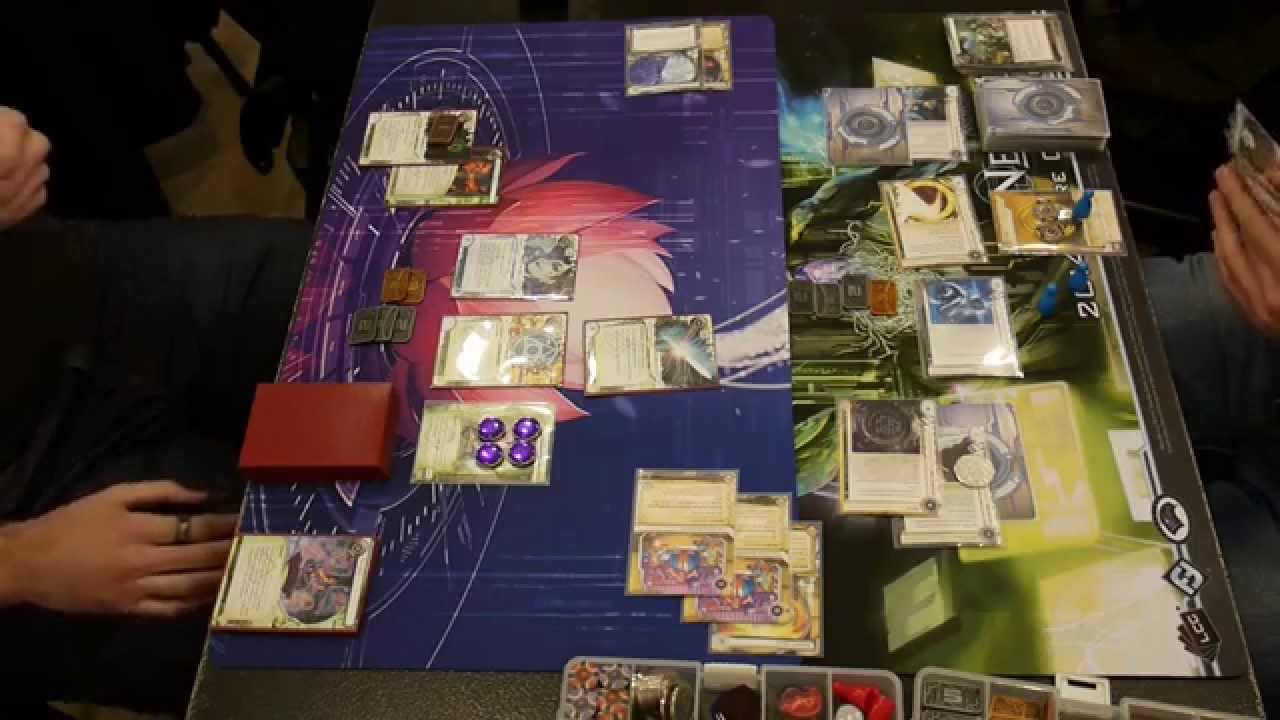 |
| Netrunner tournament match |
My favorite LCG discovery this past year is
Netrunner: Android, which is based on the world of William Gibson's Neuromancer, which later inspired a great RPG (to be discussed later),
Shadowrun. It is a two-player asymmetrical card game, which means each player builds and then plays with their own deck of cards, and each type of deck (a runner or a corporation) builds completely different type of decks. Runners are hackers. Corporations defend themselves against hackers.
Proof that card games and table-top gaming are truly changing the entire gaming scene is illustrated nowhere better than with
Hearthstone, a video-game that plays like a table-top card game. Developed by World of Warcraft, it now has more buzz than WoW itself. It's free, and worth checking out if you are snowed in some day this winter.
My absolute favorite deck-building game is
Star Realms, and I can't recommend it highly enough. It has very simple game-play and a fast learning curve, comes packaged like a traditional deck of cards, but also develops out into an incredibly complex game, as you develop strategies for your fleet of ships and colonies. Like many games I'm mentioning in this post, there is also a mobile app adaptation.
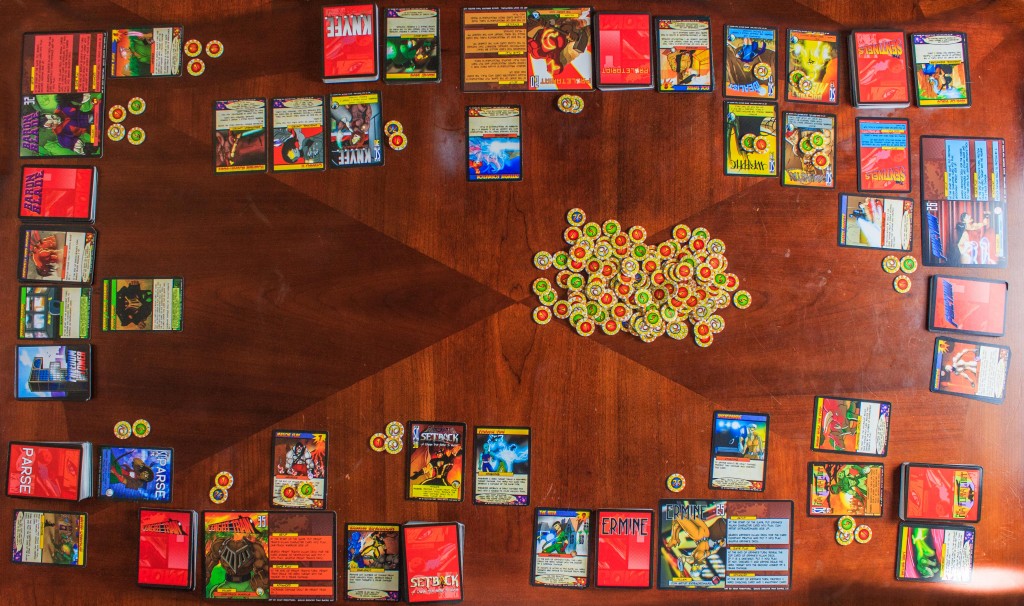
The other card game we've spent a lot of time collecting and playing this past year, is the co-operative
Sentinels of the Multiverse. You team up together with other superheroes to defeat a villain in a setting of the multiverse. The art and game play are both top-notch, and if you defeat the villain, you all win.
All these card games are satisfying on a variety of levels, including the game-play itself, the opportunity to collect cards, and the opportunity to compete against others. For example, Netrunner afficianadoes attend tournaments, share
best deck builds, and even
podcast strategies for game-play.
To discover tons more games along the lines of these, I highly recommend the Roseville, Minnesota based
Fantasy Flight Games.
Role-Playing Games
Of course, the reason so much of the gaming universe changed can be traced back to the rise of role-playing games in the latter part of the 20-century. For this, we have Lake Geneva, Wisconsin and Gary Gygax to blame. The perennially popular Dungeons and Dragons (which recently received an amazing update in its 5th edition) changed the face not only of table-top games, but video games, fantasy novels, and so much more. 2015 saw a number of books arrive analyzing the cultural implications of RPGs. Michael Witwer's
Empire of Imagination, though not particularly well-written, describes the business side of Dungeons & Dragons well. For the culture, read
Of Dice and Men. And for the absolute best and fascinating account of RPGs in history and philosophy, read Jon Peterson's
Playing at the World.
RPGs are what my son and I spent the most time playing this year, but we played the spin-off of Dungeons & Dragons (also now larger than D&D).
Pathfinder came out as an open-source gaming platform while D&D was transitioning from version 3.5 to version 4.0. Pathfinder is crunchier than D&D 5th edition (which means the rules are bit more complex and the mechanics specific). But the appeal is the
Pathfinder Society, which allows players to register for games all across the country and then play them at local game stores. This is how my son and I most frequently play. We now have three game stores in Fayetteville, Arkansas, and a few more in neighboring towns.
As a by-product of playing Pathfinder, I've been geeking out and reading the core rulebooks for a variety of other RPG systems. The ones that intrigue me the most include Shadowrun (mentioned above, which is a gaming system that includes both near-future technology and magic),
Numenera (earth one billion years in the future, when technology sufficiently advanced is indistinguishable from magic),
Thirteenth Age (which my brother has begun playing), and Microscope, an incredibly intriguing meta-game. And finally, the trio of
Star Wars RPGs that have come out in the last three years, each of which allows game-play as part of a different aspect of the Star Wars universe. Not only are the rules intriguing, they also serve as great omnibus reads to prepare all of us who are anticipating the new movie coming out next week.
Outliers
Finally, I think a lot of us play more games, and are exploring a wider array of games, because we like the tactile dimensions of playing games with others. Video games aren't going away, and will remain the bigger industry, but there is just something about cards, and play pieces, and sitting down at table with others.

Some other favorite discoveries of the year, games that are even more difficult to describe (although many web sites like Board Game Geek offer spectacular reviews) but absolutely fun to play, include:
Galaxy Truckers--you build a ship out of garbage and then use it to travel the galaxy
Cosmic Encounter--epic battles between competing alien races
X-Wings--use models of Star Wars ships to compete in military skirmishes. This will surely be the game of the year. It's everywhere, and really fun.
Twilight Struggle--a game of the Cold War, and probably the best board game on the planet.
http://fivethirtyeight.com/features/designing-the-best-board-game-on-the-planet/
Kids
I asked the kids which games were their favorites of 2015. The family winner was Apples to Apples, which has been around a while. The
new junior edition was a particular hit. My good friend gave us a copy of
Sushi Go, also a hit. And the two our youngest requests to play frequently include
Labyrinth (a children's Eurogame), and
Tetris and
Angry Birds, both card-game adaptations of video games.
So why do these games matter to me? Well, I guess I'm probably riding along on a sub-culture Zeitgeist. Many of my friends have ramped up their game-play in recent years. Perhaps we're attempting to escape for a bit back to some of the leisure we had as children. But I also think in the Internet age, and the era of gamification, there's really something about turning off the devices, gathering around a table, and losing yourself in a game. The collector aspect of the game taps into another part of our hobby and play, and the rise of game parlors as alternative third spaces (beyond the proliferation of book stores and coffee shops) means an intriguing shift in our culture as a whole.
So finally, there's simply lots more cultural analysis of game culture. So I'll end this very long post with a few excellent references for further reading. But before you read too much, check out one of the games. Grab some friends. And consider what you might bring from play back into real life.
On inclusion:
http://geekandsundry.com/5-tips-for-better-inclusion-in-tabletop-games/
On crowdfunding:
http://fivethirtyeight.com/features/crowdfunding-is-driving-a-196-million-board-game-renaissance/
Gen Con:
http://geekdad.com/2015/08/favorite-things-gen-con-2015/

 These were favorites of this year in a variety of genres.
